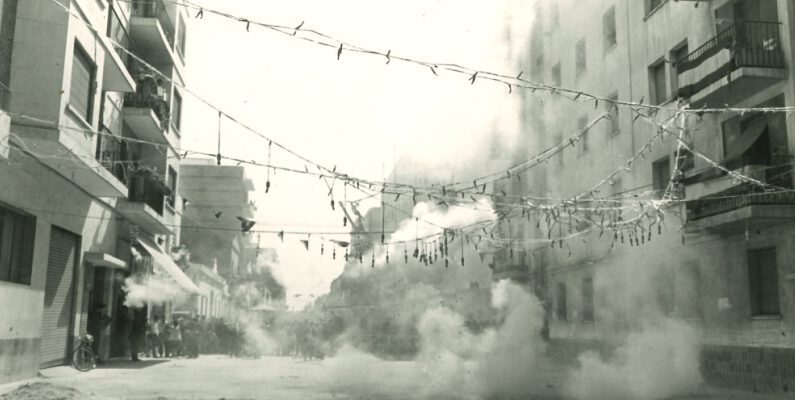
La Malvarrosa is located in the Vega de Valencia, next to the sea, surrounded by Cabanyal, Benimaclet and Alboraya. In its origins, orchards and fishermen's barracks stretched around it. It was not until 1848, with the arrival of Félix Robillard (the botanist's senior gardener), that the rehabilitation of the area began. In 1860, Robillard opened an arboriculture establishment, and later, an essences factory. The flora of the area made it possible: in fact, a variety of mauves gives the neighborhood its name. This plant, in addition to draining the soil, absorbing moisture, was used to extract its essence and create perfumes. Robillard inadvertently helped give this beach in Valencia its name, by allocating three kilometres of land to the cultivation of this plant. At the same time, the Via Pedrera del Puig was built, used to bring stone blocks to the port for the breakwater. It was a terrain crossed by ditches, from that of the Chain, up to that of Vera, joined by two branches that went through the current Avenida de la Malvarrosa. Highlights include “El Barriet”, the beach chalets, the Ballesteros coal factory and La Papelera. This "no man's land", between the sea and the orchard, hosted illustrious characters such as Blasco Ibañez, and summer houses of illustrious and bourgeois characters. Time turned the neighborhood into a place for the humble and hardworking people, who struggled to make their way within the city of Valencia. But always with an advantage: living facing the sea.
OUR FAILURE IN THE HISTORY OF THE NEIGHBORHOOD
(notes from the book "History of the Malvarrosa (born OF water)" by Antonio Sanchis Pallares)
Chap. XXXI – The faults: Before the war, a fault was planted on the land of Warrenetti-Bitulithic - pavement factory for asphalting. That fault was built in the corral of Tio Pepe's barracks, beyond the Via, near the fountain of San Vicente. Rafael Limonge, the painter, helped make and plant it as a child. It represented a ball of the world, but there are no more details on the matter. The first post-war fault was planted next to the picnic area of the Genesis. It had been painted in the house of Don Manuel Novella, the husband of the yaya Consuelo Garcín. Although the first argument that remains on record is that of 1944, and refers to the extrapolation. The artists are the same falleros, and they say that: "there are those who have posed very gross, since they try to scale in sugar and rice". Immediately, Daniel Muñoz Martin, president of celebrations, asks permission to organize festivals on July 5 and 6, 1944 at the outdoor venue immediately to the architectural garden, located at Camino Malvarrosa 14. President Puchol does not forget to send to Junta Central Fallera the photo of the major fallera for the 45 fault: Merceditas Ferrer Forés, who visited the asylums of San Juan de Dios and del Carmen, and gave donuts to the children. Competition arises from the failure of Via Puig, which is healthy. At the intersection of the avenue with the Camino Vera, another commission is formed, surrounded by the wastebasket and Robillard workers. For the presentation of the fallera mayor, Casa Insa lends them the labradora suit for free. This does not prevent them from wanting to give the commission more flights than the Via failure. For this, in addition to the mass in the Ermita de Vera, "the child who was born closest to San Jose will be baptized. If there are many, the poorest is chosen.” A "lunch at the Ximo bar for the poor solemnity of the neighborhood" is also organized on March 19, 1947, at 2 a.m. Channels of communication with the Junta Central Fallera were not very fluid, as it "cannot go to Malvarrosa in view of the impossibility of traveling to such distant places". If they want to seal the books, the secretary will have to move to the center of the city. Those from Puchol asked permission in 1948 to hold a raffle for 10,000 pesetas on assorted items. The FCB responds that this is too much for such a small category of failure. The theme of '49 is an acute problem of the neighborhood, the lack of electric light. It all depends on his majesty, the Cresol, which is the image that crowns the fault. It was the first year that I acted as a homologate. Because in order to constitute the commission, it needed an endorsement from the Phalange. It is offered by Jose Belda (with FET card no. 17,257) and Miguel Belenguer (16,360 MV).
The 49 flood All this maremagnum had its repercussions on the faults. Pepe Puchol explains to JCF that his Genesis was completely flooded, the documentation of the fault disappearing, which prevents it from being planted in 1950.
SANCHIS PALLARES, Antonio. History of Malvarrosa (born of water). VALENCIA. Department of Culture, Festivals and Fairs, 1994
(notes from the book "History of the Malvarrosa (born OF water)" by Antonio Sanchis Pallares)
Chap. XXXI – The faults: Before the war, a fault was planted on the land of Warrenetti-Bitulithic - pavement factory for asphalting. That fault was built in the corral of Tio Pepe's barracks, beyond the Via, near the fountain of San Vicente. Rafael Limonge, the painter, helped make and plant it as a child. It represented a ball of the world, but there are no more details on the matter. The first post-war fault was planted next to the picnic area of the Genesis. It had been painted in the house of Don Manuel Novella, the husband of the yaya Consuelo Garcín. Although the first argument that remains on record is that of 1944, and refers to the extrapolation. The artists are the same falleros, and they say that: "there are those who have posed very gross, since they try to scale in sugar and rice". Immediately, Daniel Muñoz Martin, president of celebrations, asks permission to organize festivals on July 5 and 6, 1944 at the outdoor venue immediately to the architectural garden, located at Camino Malvarrosa 14. President Puchol does not forget to send to Junta Central Fallera the photo of the major fallera for the 45 fault: Merceditas Ferrer Forés, who visited the asylums of San Juan de Dios and del Carmen, and gave donuts to the children. Competition arises from the failure of Via Puig, which is healthy. At the intersection of the avenue with the Camino Vera, another commission is formed, surrounded by the wastebasket and Robillard workers. For the presentation of the fallera mayor, Casa Insa lends them the labradora suit for free. This does not prevent them from wanting to give the commission more flights than the Via failure. For this, in addition to the mass in the Ermita de Vera, "the child who was born closest to San Jose will be baptized. If there are many, the poorest is chosen.” A "lunch at the Ximo bar for the poor solemnity of the neighborhood" is also organized on March 19, 1947, at 2 a.m. Channels of communication with the Junta Central Fallera were not very fluid, as it "cannot go to Malvarrosa in view of the impossibility of traveling to such distant places". If they want to seal the books, the secretary will have to move to the center of the city. Those from Puchol asked permission in 1948 to hold a raffle for 10,000 pesetas on assorted items. The FCB responds that this is too much for such a small category of failure. The theme of '49 is an acute problem of the neighborhood, the lack of electric light. It all depends on his majesty, the Cresol, which is the image that crowns the fault. It was the first year that I acted as a homologate. Because in order to constitute the commission, it needed an endorsement from the Phalange. It is offered by Jose Belda (with FET card no. 17,257) and Miguel Belenguer (16,360 MV).
The 49 flood All this maremagnum had its repercussions on the faults. Pepe Puchol explains to JCF that his Genesis was completely flooded, the documentation of the fault disappearing, which prevents it from being planted in 1950.
SANCHIS PALLARES, Antonio. History of Malvarrosa (born of water). VALENCIA. Department of Culture, Festivals and Fairs, 1994
MALVA-ROSA FLOWER
Herbaceous plant of the geranium family, with trilobal leaves, with the smell of pink and pink flowers. Used in gardening and to make essences. Originally from China, the plant is also abundant on the Mediterranean coast. It is best developed in sandy areas, such as beaches, as their land contains many minerals. It requires a lot of sun, and there are 19 different varieties in this country. Its flowers are wide and open completely in evrano. They are unique and double, with large white and pink petals, sometimes even red. They bloom from April to October, and usually die after flowering. Its scientific name is Phyneas Rosa.
Herbaceous plant of the geranium family, with trilobal leaves, with the smell of pink and pink flowers. Used in gardening and to make essences. Originally from China, the plant is also abundant on the Mediterranean coast. It is best developed in sandy areas, such as beaches, as their land contains many minerals. It requires a lot of sun, and there are 19 different varieties in this country. Its flowers are wide and open completely in evrano. They are unique and double, with large white and pink petals, sometimes even red. They bloom from April to October, and usually die after flowering. Its scientific name is Phyneas Rosa.